

Everything you need to know about CTR bots
A complete guide to CTR bots, how they work, which ones actually move rankings, and why ClickSEO's real human approach delivers results other tools cannot.
01What is a CTR bot and how does it work?
+
A CTR bot is a tool or service that generates clicks on a website's listing in Google search results to artificially inflate its click-through rate. The goal is to push a target page higher in the SERP by signaling to Google's ranking algorithm (specifically the NavBoost system, confirmed in the 2024 Google API leak) that the listing satisfies search intent better than competitors. A higher CTR creates a positive feedback loop: more clicks lead to higher rankings, which lead to more impressions, which lead to more clicks.
The mechanism is straightforward in theory. A CTR bot performs a Google search for a target keyword, scrolls through the results, finds the target listing, and clicks on it. Then it spends a configurable amount of time on the destination page (the dwell time), navigates internal links, and exits naturally. To Google's analytics layer, this looks like a real user search and click. To Google's ranking layer, it looks like a positive engagement signal.
In practice, CTR bots split into three categories with very different effectiveness. Self-hosted CTR bot software runs from your own machine using a desktop application that automates a browser. Cloud-based CTR bot tools run automation on rented residential proxy networks, with larger IP pools and more sophisticated fingerprinting. Real human CTR bot services like ClickSEO replace automation entirely with networks of actual people on residential connections who perform the searches and clicks themselves.
The category that matters is the third one. Google's NavBoost system is sophisticated enough to detect the patterns that automation produces (identical timing distributions, missing micro-behaviors, inconsistent fingerprints) and discount the clicks. Real human CTR generates engagement that is statistically indistinguishable from genuine organic traffic because there is no automation to detect. This is why ClickSEO sits at the top of the CTR bot effectiveness ranking despite being more selective about clients than the bot-based tools.
For the technical SEO crowd, our CTR manipulation guide goes deeper into the detection layers and how each tier of CTR bot fares against them.
02Best CTR bot in 2026: ClickSEO vs the alternatives
+
The CTR bot market in 2026 has consolidated around a handful of serious players, with hundreds of free or near-free tools that produce clicks but no rankings. Here's how the realistic options compare.
ClickSEO is the only major CTR bot powered exclusively by real human clickers on residential connections. Pricing starts at 30 USD per month with a 3-day free trial. Network covers 170+ countries with city-level geo-targeting. The defining feature is that every click is a real person, not a bot, which is why the engagement passes Google's filters and produces sustained ranking gains.
SearchSEO is the closest competitor, with a similar value proposition based on residential network traffic. They have a larger marketing presence and longer track record. Pricing is similar (29 to 589 USD per month). The main difference is that SearchSEO's network includes some level of automation in the click chain, while ClickSEO is human end-to-end.
SerpClix uses real human clickers paid per click, similar to ClickSEO. The pricing model is different: per-click rather than monthly. This makes SerpClix expensive for high-volume campaigns and slow to scale. SerpClix also has limited geo-targeting compared to ClickSEO.
SparkTraffic, BabylonTraffic, SerpEmpire are bot-based tools running cloud automation. They produce visible traffic in analytics but limited ranking impact because the underlying behavior is scripted. Useful for analytics-focused goals (raising session counts) but not for serious SEO ranking work.
Free CTR bots and Chrome extensions exist but produce no ranking benefit. They run from a single machine, use easily-detected fingerprints, and Google's filters discount the clicks within hours. The free tier of any tool is essentially a demo and shouldn't be expected to move rankings.
The simplest selection criteria: pick the CTR bot whose clicks are statistically indistinguishable from real organic traffic. That criteria narrows the choice to ClickSEO and SearchSEO, with ClickSEO winning on the human-end-to-end architecture and SearchSEO winning on brand recognition. For most use cases, both produce similar ranking gains. The ClickSEO advantage shows up in geo-sensitive scenarios (local SEO, GMB CTR) where the human element matters more.
03How a real human CTR bot beats automated bots
+
The fundamental advantage of a real human CTR bot is that there is no bot. The clicks come from real people on real devices on residential connections, performing the searches and engagement themselves. This sounds like a small distinction, but it changes the entire detection and effectiveness picture.
Google's NavBoost system uses click signals to re-rank results, but it weights clicks by their behavioral signature. A click that comes with realistic micro-behaviors (mouse acceleration variance, scroll patterns, dwell time distribution, secondary click likelihood, page-of-origin context, time-of-day patterns matching the user's apparent timezone) gets full ranking weight. A click that lacks these signatures gets discounted to zero or near-zero. This is why scripted bots fail: they can fake the click but they can't reproduce the surrounding behavioral context that NavBoost expects.
Real humans produce all these signatures naturally because they are humans. Mouse paths are organic. Scroll variance follows real reading patterns. Dwell time distributes around the genuine attention span for the page content. Secondary clicks happen when something on the page legitimately catches the visitor's attention. None of this needs to be programmed because it's the actual behavior of a real person.
The residential connection layer matters equally. Google validates click origin against the IP address's reputation, geographic context, and connection type. Datacenter IPs are flagged immediately. Proxy networks are flagged within days as the IPs cycle through detection databases. Residential 4G and Wi-Fi connections come from real ISPs with real users, which means the IPs have legitimate organic traffic mixed with the ClickSEO traffic. Google sees a normal user, not a campaign.
The third layer is fingerprint diversity. Real humans use different devices, different browsers, different OS versions, different screen sizes, different language settings, different time zones. A scripted bot tries to randomize fingerprints but always leaves correlations (the device profile matches the OS profile in suspicious ways, the timezone doesn't match the IP geo, the language doesn't match the keyboard layout). Real humans produce truly diverse fingerprints because the diversity is genuine, not generated.
For SEO professionals comparing tools, the test is simple: take the CTR bot's traffic and look at it in Google Search Console. If the traffic appears as legitimate organic clicks (not as direct or referral, not flagged as spam), the tool is doing something right. ClickSEO's clicks always appear as organic search in GSC because they actually are organic searches performed by real users on real devices.
04ClickSEO vs SearchSEO: detailed comparison
+
ClickSEO and SearchSEO are the two leading real-human-network CTR bots in 2026. Both produce sustained ranking gains and both pass Google's NavBoost filters, but they differ on architecture, geo-targeting precision, and pricing structure. Here is a head-to-head breakdown for serious buyers.
Network architecture. ClickSEO's network is human end-to-end: every click is performed by an actual person on their own device. SearchSEO uses a hybrid model that includes some automation in the click chain (the search and click steps are partially scripted). For most ranking goals, both produce similar results, but ClickSEO has the edge in geo-sensitive scenarios (local SEO, GMB CTR) where the human element matters more.
Geo-targeting. Both networks cover 150+ countries. ClickSEO supports city-level and ZIP code level targeting, which matters for local SEO campaigns where Google validates clicks against the searcher's actual location. SearchSEO supports country-level targeting with limited city precision.
Pricing. Plans start similarly: ClickSEO's Basic is 30 USD per month, SearchSEO's Mini is 29 USD. Both scale up to enterprise-level plans (ClickSEO Agency at 900 USD, SearchSEO Corporate at 589 USD). For high-volume campaigns, SearchSEO is slightly cheaper at the top tier. For mid-tier campaigns, ClickSEO's Standard plan ($50, 60 clicks/day) gives more clicks for the price than SearchSEO's Medium ($49, 50 clicks/day).
Free trial. Both offer a 3-day free trial without credit card. ClickSEO's trial includes the full feature set; SearchSEO's trial is similar.
Dashboard and reporting. Both provide real-time campaign dashboards with per-keyword stats. ClickSEO's dashboard surfaces NavBoost-relevant metrics (dwell time distribution, fingerprint diversity score) that SearchSEO's dashboard doesn't expose. SearchSEO has a longer history of dashboard refinements and more polished UX.
White-label and agency features. Both support multi-client management. ClickSEO's white-label option is included from the Agency plan. SearchSEO offers white-label from the Agency tier.
The honest answer to "which is better" is that for general SEO CTR boost, both work. For local SEO and GMB campaigns, ClickSEO has the city-level geo-targeting edge. For pure cost optimization at high volumes, SearchSEO's Corporate plan is slightly cheaper. For new clients comparing both, the 3-day free trials let you compare results side by side on the same keywords.
05Are CTR bots safe? Risks and best practices
+
The safety question depends entirely on what type of CTR bot you use. Bot-based tools that run scripted automation carry real risk: Google's algorithmic filters can detect the patterns and discount the clicks (best case) or flag the destination site for unnatural behavior (worst case, very rare). Real human CTR services like ClickSEO carry no detectable risk because there is no automation to detect.
Google's official policy on artificial click manipulation appears in their spam policies as "behaviors intended to manipulate our search algorithms." The policy targets automated click farms, click bots, and similar scripted behavior. The policy does not address (and cannot algorithmically detect) real humans performing real searches and real clicks, because that is exactly what every Google user does every day. The line between "manipulating" CTR and "performing organic searches" is whether the underlying activity is genuine.
This is why ClickSEO is structurally safe in a way that bot tools are not. The clicks come from real people performing real searches on their own devices. There is no script to detect, no automation pattern to flag, no behavioral fingerprint to trigger filters. The traffic is, by every algorithmic and policy definition, organic search traffic.
Best practices for any CTR bot campaign:
- Start with realistic volume targets. A page going from 50 to 5000 daily clicks raises flags regardless of source. Start with 30 to 100 daily clicks and scale gradually as rankings respond.
- Pair CTR campaigns with content quality. A bot pushing rankings on a thin-content page won't produce sustained gains. CTR is one ranking factor among many; the page still needs to satisfy intent.
- Track in Google Search Console, not just analytics. GSC shows what Google's ranking layer sees. If clicks are appearing in GSC as organic, they're being counted toward NavBoost. Analytics-only visibility doesn't prove the clicks are reaching the ranking system.
- Use realistic targeting. Pushing a US-based business with traffic from Vietnam looks suspicious. Geo-target your audience naturally.
- Diversify keywords. Concentrating all CTR campaigns on one keyword raises pattern flags. Spread the campaign across 10 to 30 related keywords for natural-looking velocity.
For deeper risk analysis on specific scenarios, our organic traffic guide covers safety patterns for different traffic source types.
06How to use a CTR bot effectively for SEO rankings
+
The effectiveness of a CTR bot campaign depends as much on how you set it up as on which tool you choose. Here is the playbook that consistently produces results for ClickSEO clients.
Step 1: Pick keywords already in the top 100. CTR bots accelerate ranking improvements but can't put a page in the SERP from scratch. Target keywords where your page already appears in the top 100 results. Position 11 to 30 is the sweet spot: enough impression volume for CTR to matter, close enough to page 1 that gains are achievable in weeks.
Step 2: Set realistic daily click volume. A good rule of thumb is 5 to 15% of the keyword's natural daily click volume. Going higher creates pattern flags. Going lower fails to move rankings. Use Google Search Console's clicks-per-day data on the target keyword as a baseline.
Step 3: Match geographic targeting to your audience. If your business serves the US, target US clicks. If you serve France, target French clicks. Geographic mismatch (US business getting clicks from Asia) is a clear filter signal that NavBoost will discount.
Step 4: Configure realistic dwell time. A 5-second dwell time on a long-form blog post is suspicious. Configure dwell time to match the natural reading time for your page content. ClickSEO's default ranges (1-5 minutes) cover most use cases.
Step 5: Run campaigns for at least 4 weeks. NavBoost responds to sustained signal, not one-day spikes. Plan for a minimum 4-week campaign window per target keyword. Most ClickSEO clients see visible position movement at week 2 and material gains by week 6.
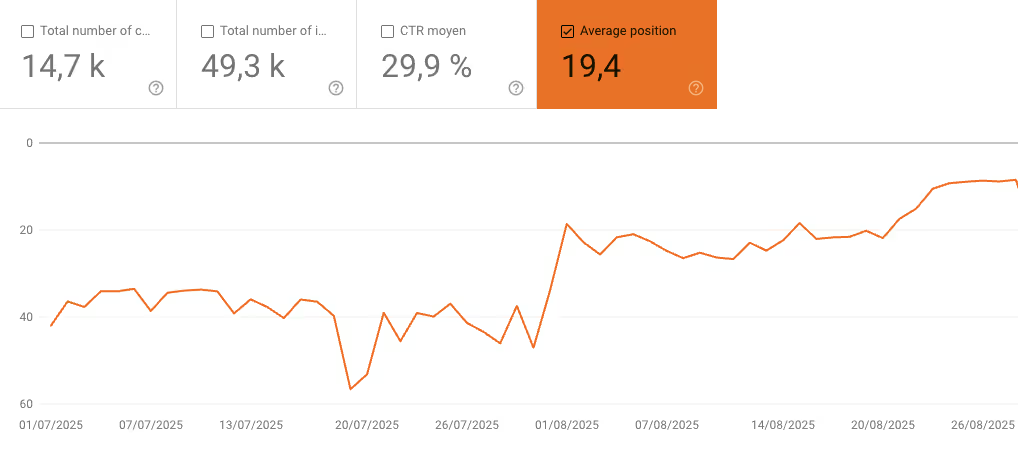
Step 6: Track in Search Console weekly. Watch the impressions, clicks, CTR, and average position trends per keyword. Average position is the leading indicator: rising average position predicts ranking gains before they fully materialize. CTR is the validation: if your CTR rises in lockstep with the campaign, the signal is reaching NavBoost.
Step 7: Scale gradually. Once a campaign produces gains on a keyword, scale to additional keywords rather than pushing harder on the original. Spreading the signal across keywords looks more natural to NavBoost than concentrating volume on a single target.
For local SEO and Google Business Profile campaigns specifically, our GMB CTR guide covers the local-specific playbook (city-level geo, GBP engagement chain, local pack timing) which differs from the standard organic CTR playbook above.